This is a personal account and does not express the views of the US Peace Corps

Wednesday, November 23, 2011

Food of Bokito


Life in Bokito is still slow. Thanksgiving is upon the states and I haven’t been this homesick since I’ve left. Thinking of family and friends surrounding a table of my favorite foods at home . However, our little community here is determined not to let that get us down. On Saturday, the other programs are coming out to our little village to celebrate Thanksgiving with our version of Thanksgiving. It’s potluck style, so we’ll see how it goes. J But we are getting some chickens and everyone is pretty invested, so I’m it will be fun.

Since food is the topic of the day, I figured I’d take this blog post to talk about the food of the Center Region of Cameroon. Please note, with Cameroon’s huge ecological diversity, this diet is really region specific. I’ll be sure to update with a menu of the north when I get up there.

Down here in the center, we are in the rainforest. We have an abundance of fresh fruit and vegetables, but a lack of meat (or well it’s available but extremely expensive). We are close enough and have roads that are good enough that we are able to get frozen fish from the coast.

The cuisine has a distinct French influence, including baguettes, beignets, and omelets. However, they have also retained their African roots, including using massive amounts of oil (mostly palm oil) in every meal.

This is my typical fare in a day:

Breakfast: a baguette and a 2 egg omelette with onions, tomatoes and a cube of MSG in it. It is also fried in about 2 inches of oil, sometimes palm oil (a disgusting saturated fat) or vegetable oil. I’ve been able to figure out a system of easting just enough to keep me going for the morning and passing off the rest to the kids in my family. They don’t really eat breakfast, unless it’s leftovers from the night before. (PC informed them we couldn’t have leftovers because unheated food is a breeding ground for cholera and other fecal-oral diseases). So I’m happy to provide them with a few calories before we all head off to school.

Snack time: On school days, during coffee break, an entrepreneurial women has taken to stopping by the center to sell us Pili-pili: the African version of fried calzones. They are awesome fried dough pockets filled with fish and vegetables and MSG. Then we head to the kitchen for our coffee, which we drink African style with sweeten condensed milk.

Lunch time: Lunch is a pretty enjoyable experience most of the time. My family is the acting “lunch lady” at the Bokito training center, so everyday my host sister shows up with a wheelbarrow full of food. This typically consists of red beans, white rice, spaghetti (cooked in palm oil), an awesome cabbage/carrot dish, “legumes” which are often steamed cassava leaves, “ndole” which is another type of green leaf stewed with fish, fried plantains, fried fish, and a tomato sauce. For condiments, we have mayo, MSG in liquid form (Maggi Arome), and piment, the Cameroonian equivalent of hot sauce (which I have of course jumped on enthusiastically). Sometimes theres also fresh fruit for sale. On days when we don’t buy from the lunch lady, we can go out into town and grab a baguette filled with beans and hardboiled eggs, or tomato sauce and onions.

Dinner time: this is the only meal that I’ve really been exposed to Cameroonian style eating as it’s the only meal I eat with my family. Dinner consists of  a starch: often a root vegetable such as cassava, potato, sweet potato, or some other tubules I’d never heard of before called manioc and macabo. If the starch isn’t a tubule, it could be rice, or a “couscous” which is actually more like cream of wheat (corn, manioc, or rice is powdered and boiled to create a paste). The other option (which is probably my favorite, is called “baton de manioc”. It’s manioc paste that has been wrapped in banana leaves and allowed to ferment for a few days. I love it.

In addition to the starch, we’ll have a main dish. This is almost every night fish in a peanut, tomato, or simply MSG broth sauce. Extremely delicious. The only times we haven’t had this combination we had either fried fish, a sauce with beef in it, or this dish called sangha which is corn and cassava leaves sautéed in palm oil

In case you haven’t figured it out yet, MSG and palm oil are huge staples in Bokitotians diets.

The best part about dinner, is watching my family eat. They put away so much freaking food. Imagine a regular sized dinner plate. They will take this and put a heaping mound (let’s say 4 potatoes or 3 cups of rice) on their plate and a piece of protein (very small, and the piece gets smaller as you get younger. Often kids won’t get meat at all in typical households. As you can imagine, this leads to huge malnutrition issues) and tons of sauce. They put that back in 5 minutes flat and can still eat more. It’s insane. I don’t understand how these guys are dying of hypertension and obesity yet. Although, hypertension and diabetes is on the rise here in Cameroon.

Most days I really enjoy the taste of the food here. As long as I don’t think about what’s in it, I’m pretty happy. But, I have developed an aversion to palm oil which has really hindered my culinary experience here. The taste of palm oil actually causes a gag reflex now. And there’s no hiding that taste either. It leaves a coating in your mouth as if you’ve just consumed a whole tub of cool whip. Gross. Anyways, besides the palm oil and MSG, things here are nice and spicy and tasty, just the way I like them. I’m trying to keep my portions more American style and sized, and have so far managed to at least not gain weight. I am looking forward to heading to the north though where there is little to no palm oil and more meat and sometimes milk. I am pretty satisfied with the palettes here, but I’m ready for the change.

Anyways, Happy Thanksgiving! Love to all! Miss all of you!

Friday, November 18, 2011

Handful of Gestures


As life settles down into a routine of PC training again, I’m branching out for topics. Thanks for the awesome suggestions readers. This week, the topic of choice is gestures. Every country and culture have different gestures and signs, different nuances. Living in Germany, I loved how instead of “crossing your fingers” they had “press your thumbs”. In America, we have some great ones, like the middle finger, or a thumb for hitchhiking, vulgar ones such as putting the tips of your index fingers together, or completely innocent ones, like putting your palms together to indicate “prayer”.

            As I start to understand more and more of the language (side note: guess who tested “intermediate high” on their language placement test this week!!!!! I start learning Fulfulde by the end of the week in addition to my French classes.) I start to get a glimpse of these gestures and accommodate my behavior accordingly. I’ve collected a list of some good ones I’ve found:

Crossing your legs: In America, crossing your legs and leaning forward is a sign that you are paying attention. Crossing your legs is a natural part of sitting and everyone does it. Look around the room you’re in right now; how many people are sitting with their legs crossed? Probably a majority. It’s not something we think about in the states, its just comfortable. However, here in Cameroon, crossing your legs is a no-no. Crossing your legs is a sign of disrespect to everyone else in the room. Basically you are saying to them “I am the boss and way more important than anyone else in this room”. When our main goal right now is to try to make friends and integrate this isn’t exactly the best message to be sending across. But let me tell you, this is a hard habit to break! As we’re meeting with community groups in training, I constantly find myself crossing/uncrossing my legs, fiddling with my chair and trying to find some way to tie down my knees to my chair without being to obvious about. I considered just using rope, but I figured that would just be awkward.

5, or palm toward another person with fingers extended: if you start this gesture from a closed hand and open your hand, allowing your fingers to go from bent to straight, you have just completely insulted someone. It’s equivalent to a middle finger here. It means that your mom has “loose” nether regions. Needless to say, this is one I’ve used a lot, especially in the market. “I’ll pay 500 for that, not 1000.” I now understand why the vendors were so upset and never bargained down with me.

Fingertips pulled together in front of the palm:  This is how they signal “5”. Took me forever to figure that out. I was constantly thinking market vendors were aiming their fingers nails for my eyes or something.

Open palm hitting one side of a fist of the other hand repeatedly: while it may have negative or sexual connotations in the states, here it means “beaucoup” or “a lot”. The more there is of something, the more you bang your hand on your fist. This one is used surprisingly often. And by that I mean at least 20 times in every conversation. I don’t understand why people don’t develop calluses on one side of their fist.

Waving: Palm out towards someone while bringing your fingers into your palm, reopening your hand, and repeating: In America, this is a friendly wave across the room, often reserved for cute little kids: “hey cute kid hanging on the monkey bars staring at me why snot runs down your nose and into your mouth!” Here this means “come here”. This led to sooo much confusion on my part. Being white in this country means everyone is always watching us. I often have a following of little children following me around town. Wherever I go, people yell “La Blanche” (the white girl) or my name (PC does not exist in this country). So of course, many a time, kids yelling at me from across the street would get this gesture from me. I was always alarmed and confused when they would drop whatever they were doing to crowd around me. They, in turn, appeared very confused when I didn’t have a good reason for calling them over. An endless cycle of confusion. This is a habit I’m still in the process of breaking. Kids will look through the fence into our center during their lunch breaks yelling our names and so many times we’ll respond with this gesture, only to find handfuls of kids running through the gates to see what we want.

Some of the gestures that I’ve discovered haven’t been visual or physical, but oral. In America, we use things like harrumphing or snorting, tsking, or pssssting. Not exactly words, but each with definite meaning in certain contexts.

Hissing or kissing noises: This is an attempt to get your attention, particularly as your walking by. I most commonly hear this in the market as I’m walking amonst stalls “Hisss, Blanche!”, but everyday on my walk to school numerous guys hiss or make kissing noises at me, trying to get my attention. For the most part, at least in the contexts I’ve experienced, it appears to be used by guys trying to get women’s attention. All of us Americans find this completely and totally annoying. We try not to respond, although occasionally, in a bad mood, I’ll send such an evil look their way, there unlikely to try again for at least 30 seconds.

Clicking in the back of your mouth: This appears to be a sign of sympathy or agreement, very similar to our snapping our fingers when someone says something we agree with. For a while, I thought Cameroonians just constantly had something stuck in their throat.

So that’s our week’s Cameroonian Culture 101.

Tiny update on my life: doing a lot of projects for training. Today we went to the elementary school and did a quick presentation on the fecal-oral route and the importance of washing our hands (extremely necessary, especially considering the cholera outbreak in our town). Learning French and other marvelous things that I’ll hopefully be able to use at post. Did hear a great quote today, perfectly describing my PC experience so far: “The days are really long, but the weeks go by so quickly”. Every day is a struggle, but at the end of the week, I couldn’t tell you what happened with that time! I can tell you that I am happy though. I’m really looking forward to going to post, but enjoying my time here in Bokito with the other trainees and staff members.

Cravings of the week: shepherds pie, beef jerky, good dark chocolate, salami, and of course, cheese. 

Thursday, November 10, 2011

Site Visit


Pardon my hiatus last week, but I was busy travelling Cameroon. Last week, we were on Site Visit, meaning we visited our assigned posts, where we will be living and working for the next two years. It is a visit designed to help you figure out how to get to your post, meet any volunteers you are replacing or volunteers in the area, and hopefully meet people you might be working with. It’s a good chance to see the community and your host institution before the second half of training. It ended up being our first taste of freedom here in Cameroon and an amazing experience.

My post is Mogodé. It’s in the Extreme North region of Cameroon (there are 10 regions). The Extreme North is known for being deserty, Muslim, hard to get to, and for having meat (such as beef), which isn’t widely available in the rest of the country (note: no refrigerated trucks). It also takes a butt ton of time to get there. But we got to take a train!

So Saturday morning, 7 am, all of us meet up with our Community Hosts (mine is Genevieve, a young, spunky business women who is going to be amazing to work with). We got on a “Super Amigo” chartered bus (Cameroonian style- so 5 to a seat) and headed toward Yaoundé. Yaounde, if you remember, is the capital of Cameroon where we had our Orientation for our first week here. This time, though, we weren’t confined to a hotel. As our train didn’t leave till 6:30, and we had arrived around 11 (with some difficulties), we were free to explore. We went and had an amazing lunch: salad!!!! which none of us had had since we had been here. I really don’t understand the Cameroonian mentality surrounding fruit and vegetables, but no one seems to eat raw things here, and its been driving us nuts. From there, we headed out to Casino, the import grocery store that has everything a white person living in Africa could ever dream about. On the way, we stopped into a boulangerie for real ice cream and pastries. It was amazing. I didn’t actually feel adapted to Cameroon until I walked into this completely western shop and realized how out of place I felt. Getting that ice cream, while amazing, felt so weird: I loved it. From there, we walked across the street to Casino.

Funny thing about white people in an African nation, they stick out. They are targets. Locals always think we are rich, white people just there to hand out money. Apparently, people in Yaounde didn’t think differently. As we were crossing the street to enter the store, someone ran up to us and grabbed my friend’s necklace from her neck and ran away. It was only seconds, but it was so scary. He left huge red welts on her neck. It was such a reality check. We don’t blend in, we are targets. After that terrible event, we were ready to leave Yaounde.

As we boarded the train, our excitement mounted. The train was an overnight journey and each of us had a bed in little cabins of four people. We were with our counterparts but mostly clustered together. The trip was supposed to last anywhere form 12 to 15 hours, although it has been known to last up to 23 due to multiple derailings: transportation in Cameroon: C’est la vie. This rail system is different from anything I’ve encountered before. There is one path and only one route. Yaounde to Ngaoundere leaves at 6:00 pm, once a day, and Ngaoundere to Yaounde leaves at 6:20 p.m, everyday, once a day. This easy system has an awesome effect though. As you travel north, and make your different stops, everyone knows when the trains are stopping (or at least when they should be stopping). So, tons of vendors come out to the train tracks and are out there, selling local specialties on their heads, through the windows at each stop. We bought baton (fermented cassava), tons of fruit, and a few random things, like honey. Our counterparts were going crazy, staying up all night to bargain through the window for fruits and vegetables they don’t get up north. I woke up in the morning to bags of food literally covering our compartment floor. It was hilarious.

The train ended in Ngaoundere, where we disembarked, met up with some amazing people staff from PC, and tried to arrange the next part of our journey, the bus ride north. Those of us in the extreme north were taking a bus to Maroua, the capital city. So bus rides and purchasing tickets is super strange here. You go up to the counter, and reserve your spot on a bus. Then, as buses arrive, and enough people buy tickets that a bus is full, they call out everyone’s name who made it on the bus. Then there’s a mad scramble to load your luggage and get seats. Needless to say, even after all the spots are assigned, it takes about an hour or so for a large bus to leave. Sometimes, if you’re waiting for a bus to fill up, you can wait for an hour or longer before they even do the roll call.

So, we arrived in Ngaoundere and tried to get on a bus. However, lucky for us, due to a school holiday, tons of people were waiting around trying to get on buses to get back to school up north. We were told we might be on the 3rd bus. We had arrived at 7:30 in the morning. By the time we left, on the 4th bus, it was 1 pm. It was also the last bus of the day, leaving tons of people stranded in Ngaoundere for the night. We got lucky. Our little bus pulled away, filled to the brim (again Cameroonian style) and we started out 10 hour bus ride to Maroua. On the way, whenever we stopped, people would come up to the windows, selling food and wares through the windows. Such a bizarre custom but I loved it! We started seeing meat being sold on the side of the rode. As one break, we got out and tried it, and oh my god, best meat I’ve ever had in my life. It had powdered piment (a spicy pepper similar to jalapeno) on it, and I could tell I was going to eat well during my visit. Don’t ask me what kind of meat it was, but it was good.

We arrived in Maroua late at night and headed to the Case: the Peace Corps hostel for PCV’s passing through. We were welcomed by PCV’s, two of them being PCV’s we were replacing, and headed out to town. As soon as we left the Case, I could feel a difference in this city compared to Yaounde. I felt so much safer. There was no one “deranging” (franglais, I know) me, meaning, no one yelling “la blanche”, or making tsking noises to get my attention, or trying to get me to buy anything. Sure, some people watched us go by, but no one bothered us at all. It was completely different from the south. And amazing. The city automatically felt more welcoming and like home than Bafia has ever felt.

Anyways, our night passed with awesomeness as we got to know other PCV’s and heard about people in the area and our posts. The next day, we explored the city a bit as we opened up bank accounts and got smoothies (yay!). I rode my first moto in Cameroon. I’ve been on a motorcycle once before, but I was freaking scared. I climbed onto the back of this puny little bike, with my huge flashy helmet and away we revved through the streets of Maroua. It was already dry season up there, so dust flew up in our faces. As we crossed over a river, I saw that it was almost completely dried up, with people doing laundry in the river bed with the little puddles that remained of what probably is a pretty imposing river during the rainy season. The city was so quaint and much prettier than Yaoundé. I loved it. The PCV’s showed us where we can buy cheese and kitchen supplies, and salads! We ate some grasshopper a woman was selling on her head and basically just enjoyed freedom without a strict schedule in a new city.

Since it had taken so long to open bank accounts, Alice (the PCV I’m replacing) and I decided to wait till morning to leave for Mogode. The journey out there is a bit long. You go an catch a bus (similar procedure where you could be waiting for an hour or so) to Mokolo, which takes about an hour. From there, you grab a moto and head out to Mogode. It’s about a 1.5 hour drive on the back of a moto, through dusty desert on an unpaved, pretty bad road. It’s a butt bruiser. But its freaking gorgeous. You start up, just going up into the mountains, passing cute little compounds with round houses, horses, and the occasional tree. Then all of the sudden, you go over a turn, and there’s a gorgeous valley right in front of you, opening up to volcanic spires and beautiful rock formations everywhere. If I hadn’t been clinging to moto for dear life, I would have taken some amazing photos.

Mogode is also gorgeous. It’s nestled in an almost-valley in between a bunch of volcanic spires out in the middle of the desert, in the mountains. The stars at night are amazing! It’s a small little village with a post office, a police station, a few boutiques, a hospital, some schools and not much else. There’s a large catholic mission just down the street from my house. I didn’t get a chance to meet the Italians who run the place, but I’m looking forward to getting to know them.

The house I’ll be moving into is amazing. The two huge, blue steel doors are the entrance to my compound. Inside is a huge yard. I plan on doing some major gardening/minor farming projects. Since I was arriving at the end of rainy season, everything was turning from green to brown, but it was still gorgeous. Alice had soybeans, corn, tomatoes, and cucumbers. There is an outdoor kitchen that Alice has been using as a doghouse and a pit latrine (real, without a built in throne). My first night there using the latrine resulted in an embarrassing episode involved pee in places in shouldn’t be. I was out of practice, and let me tell you, it’s hard as a woman to squat an pee into a little hole! But practice makes perfect, I’ll get better as I perfect my technique.

My house is beautiful and simple. The small porch opens up into a big kitchen/living/dining room. I have a portable gas stove! Then there is a beautiful bedroom, a washroom, and a spare room that I’ll turn into another bedroom.

There is no running water in my house, so the washroom is just that, a room to bathe and let your bucket bath water go down a drain. My water comes from anearby forage. I’ll have to hire a guy to go and get me giant containers of water on his moto.

Also, I might be inheriting a dog: Kelly (renamed Nous-nous by the neighborhood). She is a gorgeous Cameroonian mutt: a one year old puppy. She is so sweet. Unfortunately, while I was visiting, she came home with a machete wound to the shoulder. Cameroonians don’t really get pets and see dogs as either guard dogs or food. Nous-nous, being American raised, was probably being overly friendly and annoyed someone with a dull machete. Anyways, we patched her up as best we could and she’ll be fine.

I spent my two days in Mogode, exploring, hiking, eating, and meeting tons of people. We hiked one of the beautiful volcanic formations and looked down into Nigeria. We ate local food and made amazing food like lentil stir fry and cucumber salads. I had these awesome local beignets (fried dough things) made from local white beans that tasted similar to chicken nuggets and almost made me melt inside. They were awesome.

I also went and visited the hospital with whom I’ll be working. It’s a small district hospital with a birthing room, laboratory, some over night wards and a non-operational operating room. After 2 years of not having a doctor, three months ago they acquired a generalist who refuses to do even any basic surgery. There were some major problems that the nurses pointed out right away: Cholera, an extremely low number of mothers giving birth in the hospital, diarrhea, ect. My mind was racing with potential projects.

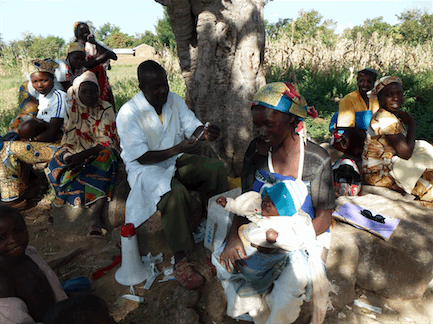
The next day, we went out “into the bush” for a vaccination day with a local village. Under a giant tree, we watched one of the nurses give vaccinations and a small presentation on the importance of breastfeeding to these women carrying infants and small children on their backs on their way to the fields. Let me tell you, this is the difference between first world and third world problems. These women, so strong and overworked, still had a sense of humor while waiting for their turn for vaccinations. Unfortunately, I couldn’t understand it. In the region where I will be working, very few people actually speak French. I’ll have to learn Fulfulde (a language most of the north speaks) and Kapsiki (the tribal language). Many women don’t ever go to school and even more don’t make it past primary school, so very few speak anything other than their tribal language. I have my work cut out for me.
But I’m excited.

Ooo, another benefit to living up north in the desert: funny thing about deserts: there’s very little water. Funny thing about mosquitos: they need water to breed. Yeah, you guessed it; there is very little malaria in the north! I’ll only have to worry about it for a few months out of the year as opposed to every day!

This long update is coming to a close, I promise. We traveled back without incident, making it back to Bokito in one piece, although missing our posts the moment we left. Most other people had a similarly great and welcoming experience in our stage. I will also have a “post-mate”: an agroforestry volunteer in a nearby village (about 15 km away).

This week has been tough readjusting to school and stage. But at least we know what’s coming now and there’s a light at the end of the tunnel. We’re spending these next few weeks just enjoying our fellow stagieres and learning as much as possible before heading off to our remote locations to start changing the world.

That’s a lot for now, there’s still more I’d love to say, but I’ll spare your sore eyes. Miss you all, thanks for supporting me with emails of encouragement, and thanks for reading my long, drawn out editorials on my life. Life is good. Keep on dancing. Ciao!

Thursday, November 3, 2011

Photos of Site Visit

Update and Experiences to Come

Kelly-Nous Nous- the dog I might be inheriting

Vaccination Days out in the Bush with the hospital I'll be working with

Me, my counterpart, and Alice (the PCV I'll be replacing)

Rhumsiki- 10 minutes away from my House

More Rhumsiki
Mogode-my new home

On top of a mountain we hiked -Nigeria in the background

Alice's House (we're I'll be living as of December)


Monday, October 31, 2011

Some photos


Typical African Dance


I'm eating a grasshopper!


Packing the car: Cameroonian Style


Bokito!!!


On the way to Boko


The Sante (Health) Program 2011

Maternity Ward at the Bafia Hospital


Some of my Sisters (and my cornrows)


Me and my new Counterpart: Genevieve

My indoor kitchen

My outdoor kitchen

Me in my new caba (terrible picture of me, but the caba is freaking awesome and super comfy)

My room!

The pizza we made from scratch (including cheese!)

Our stage at the Monday Show

On the way to Boko

Stuck in the back of the truck, Cameroonian Style


A town on our road to the North

Saturday, October 29, 2011

Roller Coaster


This week has been one I will never forget. It has epitomized my experience here by being the definition of “ups and downs” while at the same time been so far out of the ordinary, that it in no way can represent the rest of my service here.

This week started amazingly. Everyone was so psyched about finding out their posts (which happened on Wednesday). Monday brought packages and letters from home. Spirits were high as we sat around eating melted Milk Duds and cheese that people’s families had sent from the states. Our language scores from our second language proficiency test came out. I was so freaking excited.

So language proficiency in broken up into 9 levels: Novice Low, Mid and High, Intermediate Low, Mid and High and Advanced Low, Mid and High. In order to be placed in a francophone region, you need to have reached a proficiency of at least Intermediate High in French and Intermediate Mid for Anglophone regions. Needless to say, I started at Novice low, alone with very few other people. My French consisted on “bon jour” and a very few words I remembered from French when I lived in Germany. My goal was to make it to intermediate. I just wanted to prove that I was learning. I was so surprised and elated to find that I had tested at Intermediate Mid! I spent all morning doing my happy dance. I could not believe it. In a mere four weeks, I went from speaking no French at all, to being able to hold very basic conversations and communicating basic needs and wants. I’m getting there! After school on Monday, we all went out for drinks to celebrate. We were in Bafia, with the other programs and all of us joined forces for an afternoon of merriment. There’s a boutique close to the training center that gets a butt-ton of business from us “blanches”. You can imagine how crowded it was when almost 50 of us stormed the place in high moods. Also, a PC Volunteer who is about to COS (Close Of Service= go home after 27 months) sold a PCT (PC Trainee) his guitar. The whole day turned into this marvelous jam session as people passed around the guitar. Really, there is nothing more “Peace Corps” than seating around, drinking crappy foreign beer, signing songs together. It was amazing.

The time to depart came all too soon and all the Santé’s (Health Programmers) climbed into the two cars to head back to Bokito, our small town. Our great spirits held as we had an oldie sign-along on the way back. Journey, the Lion King, and Elton John were bursting from our small portable speakers all the way back. About half-way to Bokito, the cocoa-bean-laden truck in front of us decided to pass the car in front of it. As it tried to get back in our lane, it veered out of control and flipped numerous times. Dust from flying cocoa beans obscured our vision as the truck finally came to rest, right side up, rolling into a car heading in the opposite direction, pinning it between the truck and the guardrail. As our bus slowed, we were so confused. What had just happened? Those of us in the back could only see dust and hadn’t seen what had happened while those in the front were awestruck. It quickly sank in and we mobilized. In our bus were four EMT’s, including myself. We hopped out and ran to scene. You can imagine what this might have looked like. A random road in the middle of greenery with us running into a cloud of settling cocoa-dust, running toward a banged up truck. It was movie-worthy. When we got close enough to see what had happened, we quickly sized up the scene. The driver, who was wearing a seat belt, was stuck in the truck, blood all over him. The four of us scrambled for gloves and materials. Two of the EMT’s were smart enough to have kept small kits on themselves, so between the four of us, we had two pairs of gloves. Two of the boys split a pair of gloves and approached the vehicle.

In a country where HIV/AIDS and other bloodborne diseases are rampant, you can imagine how important PPE (personal protection equipment, including gloves) is. Not having gloves, I ran around to the other side of the truck, to the car, to see if there were any more victims. The people in the car said they were ok, but pointed to a man lying in the group, underneath the guardrail, yards behind us. I ran over, and found someone who had obviously sustained serious crush injuries. I don’t want to get into too many details or too graphic, so I’m going to break this down quickly. The third EMT took the last pair of gloves and took charge of getting this guy into a car we had commandeered. The other two EMT’s had managed to get the driver into the back of the car, with one of the EMT’s in the back, putting pressure on the guys’ head wounds. He was ripping up his shirt trying to make bandages to help to this guy. Between two EMT’s and some Cameroonians who were at the scene and finally made themselves useful, we were able to get the second guy in the back of the car.

Cameroon doesn’t have an emergency system. There was no ambulance or police to call. We were 20 minutes away from any hospital, at least. In addition to these obstacles, in Cameroon, if you bring someone to a hospital, you’re expected to pay for that person’s hospital bills. Compared to the states, it’s nothing, but its quite substantial on a typical Cameroonians’ paycheck. Therefore, after we had loaded these two guys into some random strangers car, no one was willing to go to the hospital with these guys. No one wanted to drive and certainly no one wanted to climb into the back of the car and maintain the airway of the second patient. They argued for what seemed like hours but was probably only minutes. I got so impatient and started pointing to people, telling them to get in the car and go. These guys needed immediate help and no one was stepping up. That tactic had no effect, but eventually, arguing amongst themselves, three people stepped up to drive, accompany, and sit in the back with the guys. They drove off immediately, in the direction of the hospital and the three EMT boys were left in the dust dripping in the victim’s blood.

This was such a wakeup call to so many problems here in Cameroon. A health system that people are resistant to utilize, a culture that basically doesn’t know how to or want to respond to emergency situations, and an education system that doesn’t prepare people for situations like this but instead leaves them helpless. In addition, terrible road conditions (granted, this road was not terrible), even worse driving, and horribly maintained vehicles leave car accidents as the second leading killer in Cameroon (following Malaria, according to our PCT Manager).

As terrible as this experience was, it brought us together and showed us the many areas we could help improve upon in Cameroon. Again, I am seeing why I am here and why our presence is so precious to these people.

Gosh, my posts are getting morbid. I want to reiterate to readers that I am enjoying my time here and loving what I am seeing and learning. What I choose to write about every week is what is on my mind, and therefore, important to me and my experience. They are my learning experiences, whether good or bad. Our presence at this accident probably saved a life. While I am horrified at seeing the worst accident of my EMT career in a country and situation where we had no materials or help of any kind, I am grateful for the victims that people of skill and knowledge were there to help get them out of the car and on the way to a hospital. And I learned a lot that will hopefully help me to make a sustainable difference at my post in the future.

Speaking of posts, I have some great news. After this “down” part of my week, things went back up on Wednesday as we received our post assignments!!! I’m heading to a town called Mogodé in the Extreme North Region. I don’t know much about my specific post, but the Extreme North is known for being beautiful and mostly desert, at least during the dry season. It’s a mostly Muslim area with very traditional areas. Many of the people that I have spoken with who work up there focus  a lot on women’s issues, empowerment and health, which is exactly what I want to do, so I’m extremely excited.

Today, we had our Community Host Workshop were we met our Community Host. This person is someone who is going to help us integrate into the community. There are a well established figure in the community, well versed in the culture, and very knowledgeable about groups and issues of our areas. In addition to our formal Community Hosts, each of us will receive a counterpart in our Host Institutions where we will begin our work or at least our community assessment. So today, I met my counterpart. She is a baller, amazing young women called Genevieve. She told me that I will have to learn the language Fulfulde and the local language Kapsiki (I think that’s it) due to the fact that French won’t get me far up in the extreme north. Apparently, it’s also very much in the boonies. I’m very excited about working with her.

I wish I had more information to give you about my post and Community Host, but I just don’t know yet. This weekend, we’re leaving for our Site Visits. I will be visiting the site where I’ll be living for the next two years, meeting the PCV I’ll be replacing and meeting the people I’ll be working with and people from the community. It will take me at least two days to get to my post. I’m so excited. Anyways, when I return, I will update you all on my post, and everything I will learn about how I will spend the next two years. Wish me a bon voyage!

Love to all!

Friday, October 21, 2011

Malaria: First Hand Experience with Cameroonian Healthcare

So, first of all, thanks for all the emails and questions. I’m keeping
a bank of them and will answer them all, either by email or on the
blog. However, for this week, I have a topic already.
So, I didn’t really explain what I’m doing here. As a Cameroonian PC
Volunteer, my job is “Preventative Health and Community Development”.
I will be working with community groups (kids, schools, women’s
groups, political groups, hospitals/health centers, support groups,
ect) for the next two years with my main goal being raising the
standard of living. I will be given a “host institution”. This
institution is either a local NGO or a health center or hospital with
whom I’ll be working for at least the first few months. It’s basically
a starting point. The first few months I’ll be taking stock of the
community and assessing it basic needs. What are the major problems in
my community? How can I help reduce those problems? It will always
start with education. I’ll be focusing on preventing diseases,
particularly cholera, diarrhea, malaria, typhoid, ect by teaching them
hygienic practices and prevention measures. All is subject to change
though as I see what my community needs.
This past week, we were learning about malaria. We learned how to
recognize it if we get it and how to educate people about how to
prevent it. There’s actually a great program going on right now where
health centers and handing out thousands of free mosquito nets to
anyone who goes and picks them up. It’s a huge deal right now and a
large step towards preventing malaria, which is a huge problem here.
Talking to our families, we’ve found that on average, at least one
person gets malaria a month in each household. One house reported that
people were getting it every two weeks. The locals though have built
up a small immunity. They’ve had malaria since they were kids and now,
as adults, when they get it, its basically a mild cold. Malaria is a
small parasitic disease that is transferred through mosquitoes. If
left untreated, one of the four strains could lead to death while each
of them can result in some pretty serious health consequences.
However, people here mostly know what is it and take anti-malaria
medication as soon as they feel a fever come on. The medication is
supposed to be taken every 8 or 12 hours for a few days, and then you
are completely cured. However, you can always get reinfected. For  us,
many of us who have never had malaria before, it is a bigger deal.
It’s like a really bad flu for us. It starts with chills and serious
body aches and progresses to fevers that spike at 102 or 103. It’s
terribly uncomfortable but not dangerous as we are given treatment for
us to self medicate and instructed to go directly to a hospital (if
possible) if we feel it coming on. We also are all on malaria
prophylaxis, a medication designed to reduce the chances of us
contracting malaria.
However, despite sleeping under a mosquito net, taking my prophylaxis
religiously, and wearing long pants at night (despite the ridiculous
heat here), I contracted malaria this week. In addition to malaria, I
also got a bacterial infection.
So Thursday I started coming down with symptoms. That afternoon, we
got our malaria talk about how to deal with it for ourselves and
recognize it. I swear, as Nurse Anne was going through the symptoms, I
was checking each off in head, feeling like she had specifically
created that powerpoint for me. However, Nurse Anne was not nearly as
convinced as I was and told me to wait a day before seeking medical
attention. I headed home and slept for the rest of the day. The next
day, having no apparent fever, I go to school, only to immediately get
revisited by my fever at a much lower 102. I contracted PC and off to
the hospital we go.
On the way, I was thinking how fortunate I was to be going to the
hospital. How lucky I am to be experiencing the Cameroonian health
system from the other end, to get a taste of what patients deal with
every day. And, now that it’s over, I’m glad I did have this
experience, but it was not exactly stellar.
The first hospital they took me to was the Bafia Public Hospital. The
drive me up and walk me into the emergency room. It looks like a train
station. There are round benches with dozens of patients staring
lethargically, waiting for their turn. I felt so guilty. Being the
only white person in the room, belonging to PC, and having an “in”
with the only doctor on duty (our Coordinator was accompanying me), I
literally skipped the line completely. They called me to the corner of
the room and had started my paper work, which literally was a sheet
from the prescription pad. They wrote my name, age and gender on the
paper and ushered me into the first room. In this room, they weighed
me and took my blood pressure. Weighing me was hilarious as they had
me climb into this huge metal chair that was hooked up to a scale. I
figured they had the chair for those too sick to stand while they were
weighed, however, the way the chair was positioned (the open part
facing a wall) it was so awkward to get into, I can’t imagine anyone
preferring this method over a typical scale. Taking my blood pressure
was nothing special, although (EMT’s you’ll appreciate this) they
definitely blew it up to like 250 and kept it there for a good 20
seconds before deflating slowly. Super painful. Don’t ever do that to
a patient.
Anyways, after that I was ushered back out the way we had come and to
a waiting room in front of two consultation rooms. Both of them held
nurses and had a line backed up. However, as soon I walked up with the
Coordinator, a doctor came out of the blue, took over one of the
examination rooms and led me in. Again, overcome with guilt as I
skipped ahead of some pretty sick people including a completely
lethargic baby. By the way, in Cameroon, especially in public
hospitals, doctors don’t really get to practice medicine. They are so
overloaded they end up becoming hospital managers while nurses are the
ones who do everything except major surgeries. Many health clinic
don’t even have doctors. It’s definitely something I’ll explore and
try to work on during my time here at post. Anyways, so it was pretty
extraordinary that I got to see a doctor and not a nurse. He examined
me and talked with me. His bedside manner: completely lacking. He
obviously had places to go and was not exactly happy to be there. He
was polite though. This is apparently a very big problem in a country
where there is one doctor per 10,000 people. Medical professionals
aren’t very nice to their patients. The room we were in was so tiny,
it barely fit a desk and the examination table. The doctor didn’t wear
gloves when examining and the walls were only about 7 feet tall while
the ceilings were 10 feet high (so much for patient confidentiality;
everyone outside the room could hear what was going on).
Regardless, I was sent to go to a laboratory at a local private
hospital. This place was a little nicer and definitely less busy.
Inside was less crazy and the technician wore gloves (although they
were reused) to take my blood. Again, though, the nurse was not
exactly friendly. The doctor, on the other hand, while he wasn’t
actually working with me, came out of his office to have a hilarious
friendly conversation about how close I was to Barack Obama. The
doctor insisted that I was friends with him and therefore, the doctor
would visit me and I would introduce them. It was great. They were
also extremely efficient. They took my samples at noon and had results
and a diagnosis by 2:30. I made it back to help give a presentation at
3:30.
That was my adventure. The next few days consisted of TONS of
medications, a lowering fever and disappearing pain, fatigue, and
ridiculous amounts of nausea due to the strong medications they put me
on. The first night I vomited up everything I been able to get down
the day (which hadn’t been a lot). After 3 days, I was malaria free. A
day later, I was bacteria free. Quick and simple, for the most part.
So yeah, I got malaria. I feel bad ass about it too. I was the first
in our group to contract it, but certainly not the last. Many people
get it more than once, so I have since taking a liking to long pants
and long sleeves as soon as the light starts to fade. I’m all healthy
now, but I certainly had an interesting experience and am making a
list of things that I might want to look at, explore, and maybe work
on at my health clinic when I get there.
Next week we get our post assignments. I’m so excited! I’ll keep you
posted. Keep your fingers crossed for me that I get a good one! I
don’t really care where I am though. I could be in the South, close to
beaches, or the east, maybe working with Pygmies in the rainforest,
although the mosquitoes would be terrible. I could be in the West
areas which are gorgeous and many of them Anglophone regions , or in
the north, which becomes savannah and then desert, often populated by
Muslim populations. There are so many options; I don’t even know what
to hope for.
So hello and goodbye again from Cameroon. Please keep up the emails.
They give me strength when I feel like I just want to give up and go
home. Thanks for the support and love guys!